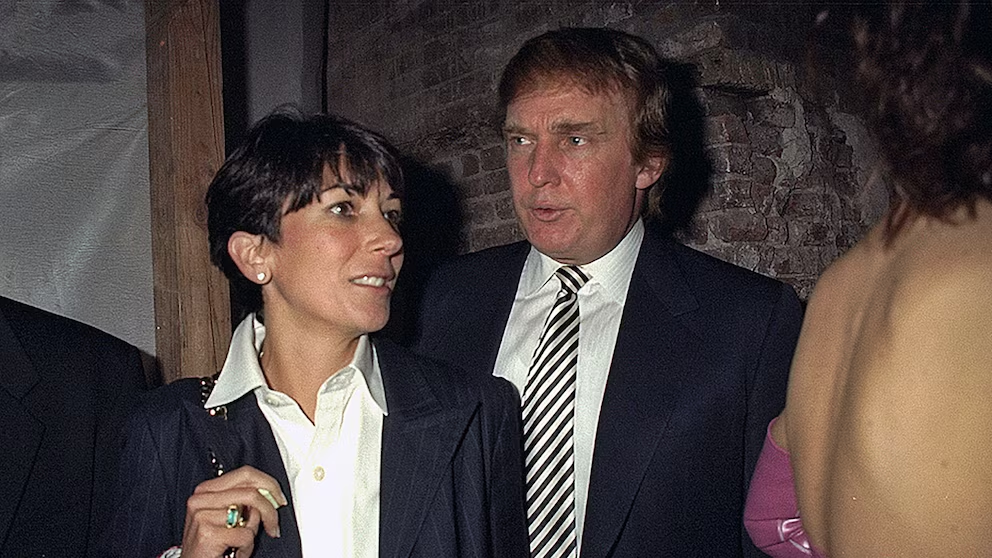
We’ve all heard about the discovery of POTUS (Donald J. Trump) in the Epstein Files by now. However, not everyone knows about the depth of the involvement so we’ve decided to tackle that in this article. But, before we begin, we would like to add that the files do not rewrite the public record on US President Donald Trump, although there is material that may prove embarrassing to the President. With that being said, grab your popcorn, because this is about to be a handful.
The newest US document dump on Jeffrey Epstein is sprawling, uneven and heavily redacted – but tucked inside are moments that have sharpened scrutiny on
President Donald Trump’s long-acknowledged past association with the notorious sex offender.
Mr Trump has long denied any wrongdoing, and the Justice Department says some claims in the files are flatly false. However, the documents do illuminate how federal investigators documented his proximity to Epstein – what they flagged, what they questioned, and what they ultimately set aside.
The result is a collection of fragments rather than conclusions, ranging from flight records to internal e-mails, and an unsettling piece of correspondence involving another convicted abuser.
Legal Glossary: The Epstein File Conflict
- Inherent Contempt: A rare and powerful authority that allows Congress to bypass the court system and directly sanction individuals—including the Attorney General—who obstruct an investigation. Under this power, the House can vote to impose daily fines (proposed at $10,000 per day in current drafts) or, in extreme cases, authorize the Sergeant-at-Arms to detain an official until they comply with a subpoena.
- Rolling Production: A common legal practice used in massive litigations where documents are released in “tranches” or stages rather than all at once. While the DOJ argues this is the only practical way to handle over a million pages, critics argue it is being used as a stalling tactic to avoid the strict December 2025 deadline mandated by the Epstein Files Transparency Act.
- Bates Numbering: A method of indexing legal documents by assigning a unique, sequential identification number to every page. This allows investigators and journalists to track exactly which pages have been released, which are redacted, and where “gaps” might exist in the record.
- Statutory Mandate: A formal requirement created by a law passed by Congress. In this context, the Epstein Files Transparency Act is a statutory mandate that strips the DOJ of its usual discretion over when and how to release files, effectively putting the Department on a “legal clock.”
Here are five takeaways from the documents now in public view.
Trump’s travel on Epstein’s jet
The most concrete new detail is an internal e-mail dated Jan 7, 2020, in which a New York prosecutor said flight records showed Mr Trump took eight trips on Epstein’s private jet between 1993 and 1996 – more than investigators were aware of at the time.

The e-mail – marking the most detailed account yet of Mr Trump’s travel alongside Epstein – says Ghislaine Maxwell was aboard at least four of those flights. Maxwell is now serving a 20-year prison sentence for offenses including sex trafficking a minor.
It also describes one flight where the only passengers were Epstein, Mr Trump and an unidentified 20-year-old whose name is redacted, plus two other flights involving women described as possible Maxwell case witnesses.
Mar-a-Lago subpoena
The newly released documents show that prosecutors issued a November 2021 subpoena to Mr Trump’s south Florida beach club Mar-a-Lago, seeking records relevant to the government’s case against Maxwell.
Attached was a letter dated February 2015, on Mar-a-Lago letterhead, in which club officials indicated they did not have the employment records from 1999 to 2001 that federal agents were seeking.
The presence of a subpoena does not imply wrongdoing by its recipient, but it does show investigators formally sought information from Mr Trump’s property as they pursued Maxwell.
Photo with Trump and Maxwell
One newly disclosed e-mail says someone reviewing data obtained from close Trump ally Steve Bannon’s cellphone found an “image of Trump and Ghislaine Maxwell”. The Department of Justice (DOJ) released the reference while redacting the photo itself.
Claims the DOJ calls false
In an unusual move, the DOJ explicitly warned that certain claims against Mr Trump in documents submitted to the FBI shortly before the 2020 election were “untrue and sensationalist”.
The batch of newly released files describes FBI “tips” collected about Mr Trump and Epstein-era parties in the early 2000s, with no clear indication in the documents of follow-up or corroboration.
A tip from October 2020 alleges that Epstein hosted a party in 2000 where someone named Ghislaine Villeneuve brought the tipster.
Someone at the party said Mr Trump “had invited them all to a party at Mar-a-Lago” and the tipster indicated that she wanted to go but was told “it wasn’t that kind of party – it was for prostitutes”.
The document does not confirm follow-up and remains unverified.
Letter to Larry Nassar

The DOJ said a disturbing handwritten letter among the newly released paperwork – purported to be from Epstein to disgraced former US gymnastics team doctor Larry Nassar – was among the false claims and fake material.
The message appeared to have been sent in August 2019, the month Epstein died by suicide – although DOJ officials said the postmark, return address and omission of an inmate number suggest it may not be genuine.
They added that the handwriting did not appear to match Epstein’s.
The letter’s author writes that Mr Trump “shares our love of young, nubile girls”, a sentence that had no verified context but had captured media attention due to its graphic tone.
The letter started, “As you know by now, I have taken the ‘short route’ home”. US media had taken the phrase to be a dark euphemism for Epstein’s suicide. AFP
What it means for the DOJ
The current release has placed the Department of Justice in a precarious position, caught between a strict congressional mandate and the logistical reality of redacting over a million newly discovered documents. By missing the December 19, 2025, deadline for a “full” release and opting for a rolling production, the Department now faces the threat of inherent contempt and an audit by the Office of the Inspector General. For the DOJ, this is no longer just about the Epstein case; it is a high-stakes test of institutional integrity. Prosecutors must now justify every “black box” redaction in writing, proving to a skeptical public—and a bipartisan coalition in Congress—that they are protecting the privacy of survivors rather than the reputations of the powerful.
Conclusive Analysis
The release of these documents does not provide a singular, indicting “smoking gun,” but rather a complex evidentiary map of a decades-long association. From a legal standpoint, the files represent a tension between verified institutional records—such as the 2021 Mar-a-Lago subpoena and expanded flight logs—and “sensationalist” claims that the Department of Justice has moved to explicitly discredit. While the flight records place Donald Trump in Jeffrey Epstein’s immediate orbit more frequently than previously documented, the heavy redactions and the inclusion of debunked correspondence highlight the difficulty of extracting actionable legal truth from a case mired in misinformation. Ultimately, these files serve as a formal record of proximity rather than a verdict of complicity, underscoring the ongoing challenge for investigators in distinguishing substantive evidence from the noise of one of the most high-profile criminal investigations in modern American history.
You can find more context on the legal implications of these types of document releases in this report on the Epstein files, which discusses the intersection of public interest and the judicial process.
More will be released over the coming weeks.
For more in-depth legal analysis, case studies, and law-focused insights, explore our latest articles or subscribe to our legal updates.
